Georgia Families Is a Program That Is Associated With What Area of Funding?

This report was written in partnership with Jyll Walsh, GBPI doctoral intern.
Early care and educational activity (ECE) centers play an integral role in the health and well-being of many children and families in Georgia. The holistic arroyo ECE centers can provide has shown to have a substantial, lasting and even intergenerational impact on health and well-being, and has the strongest outcome on children from families with low incomes.
The Georgia Department of Early Care and Learning (DECAL) is responsible for meeting the early on care and teaching needs of Georgia'south children and their families. Information technology manages Georgia's pre-K programme, licenses ECE centers and abode-based child care, administers Georgia's Childcare and Parent Services (CAPS) Program and federal nutrition programs and oversees the quality child intendance rating system. The department too houses the Head Showtime State Collaboration Office, which is charged with enhancing the quality and availability of kid care, and works collaboratively with Georgia Child Care Resource and Referral (CCR&R) agencies and organizations throughout the state to enhance early care and didactics. The FY 2021 state budget allots $54.2 million for DECAL, a $7.3 1000000 reduction from the previous year and $379 million in lottery revenue to fund Georgia's pre-Thousand plan.[i]
" Nosotros are able to provide child care for our child, merely it comes at the expense of our quality and quantity of piece of work as well every bit our mental and physical care. It does not feel sustainable." – Respondent to 2020 parent survey conducted by GEEARS
The limited power of many parents to accept admission to affordable, quality ECE was not created by the pandemic, but it has been amplified every bit a larger number of parents now struggle to balance work and caring for their children every bit schools moved to online instruction. With 657,304 children aged four and nether and about 28 pct of ECE centers temporarily closed, Georgia's working parents are feeling the stress on many levels.[2] , [3] In a contempo survey conducted by the Georgia Early Teaching Alliance for Ready Students (GEEARS), only one-third of Georgia parents reported their current kid intendance situation was manageable, 1-third had taken paid leave to provide child care and one in five reported taking unpaid time off.[4]
As some Georgians were non able to piece of work remotely and others are beginning to trickle back to work, the child care shortage is troubling news for the economy and the health and well-being of working families. The most asymmetric impact is on low-wage workers and people of color, who shoulder some of the almost severe financial and wellness burdens associated with the pandemic withal are some of the first workers called back to job sites. This is especially true for low-income parents raising young children, who are half-dozen times less likely to exist able to work from dwelling house than higher-wage workers. It is also true for Blackness and Hispanic workers, with less than ane in five Black and ane in vi Hispanic workers able to telework. And statistics show that but 34.9 per centum of working parents with young children from all income levels tin can telework.[5]
Families are non the merely ones in survival mode. The ECE industry, which typically has slim profit margins, at present faces huge losses of acquirement confronting high stock-still costs and new health and condom expenses. And with no statewide closure protocols, it is up to the individual ECE centers to residual the health and livelihood of their concern, staff and families they serve. A recent analysis by the Center for American Progress showed that without boosted financial assistance, fifty percent of the country's kid care centers will close permanently, leading to a loss of 4.5 one thousand thousand child care slots. Moreover, 29 per centum of surveyed centers in Georgia stated they could non survive endmost for more than than ii weeks without significant public investment.[6]
The federal CARES Act provided $144,237,467 to assistance ECE centers throughout Georgia to avert closures, supply personal protective equipment (PPE) to open up centers and create an accessible critical child care network for essential workers.[7] This federal relief is insufficient; it is estimated Georgia needs an additional $2 billion in the upcoming federal relief package. Adequate ECE relief funding is an essential part of the response to the COVID-19 pandemic and subsequent recovery efforts.
How Early on Childhood Pedagogy Benefits Health and Well-beingness
Helping parents engage in the workforce is a foundational piece of what ECE centers facilitate, but child care does much more to help children and families thrive. Their services are aimed at producing children who are healthy, ready for kindergarten, accept access to proper nutrition, are socially and emotionally competent, and ECE centers offer family support services. Also, ECE centers and pre-Chiliad programs that are licensed through Georgia DECAL are provided funding or other incentives to implement wellness policies, programs for healthy habits in caregivers, the Georgia Farm to Preschool program, concrete and nutrition education and more.
 Access to Diet
A key attribute of child well-being is the availability of nutritious food. The Child and Adult Care Food Program (CACFP)
and the Summertime Food Service Program (SFSP) are federal funds ECE centers tin apply to ensure children and adults throughout the land have access to nutritious meals both in the child care setting and at home. These funds piece of work past targeting counties with high rates of food insecurity and adult obesity.
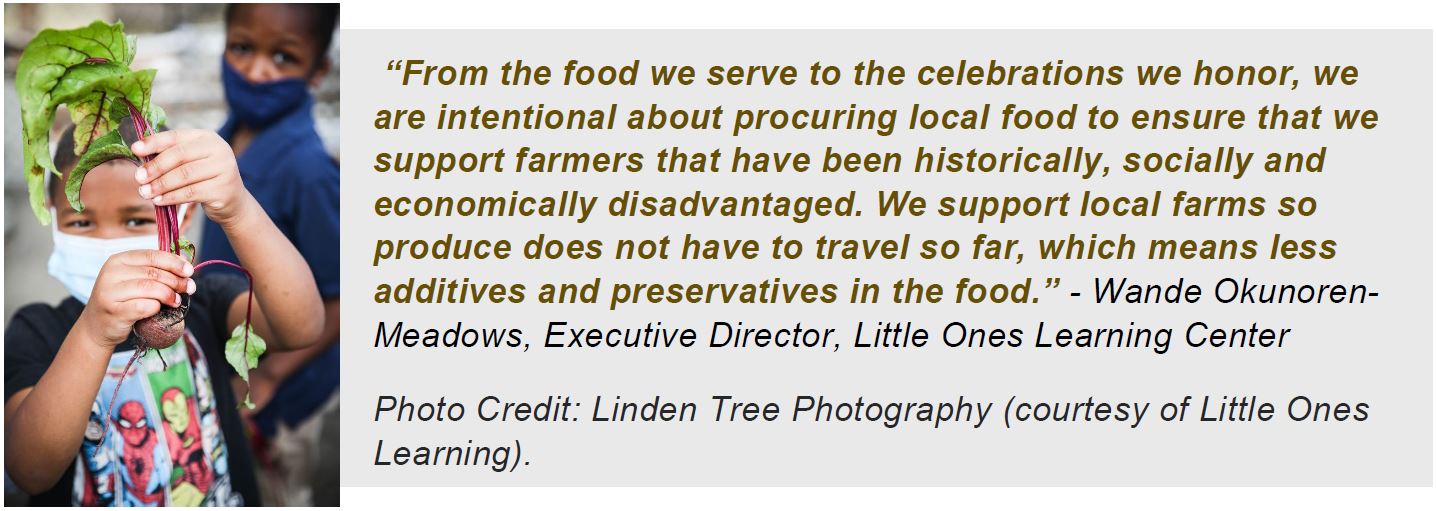
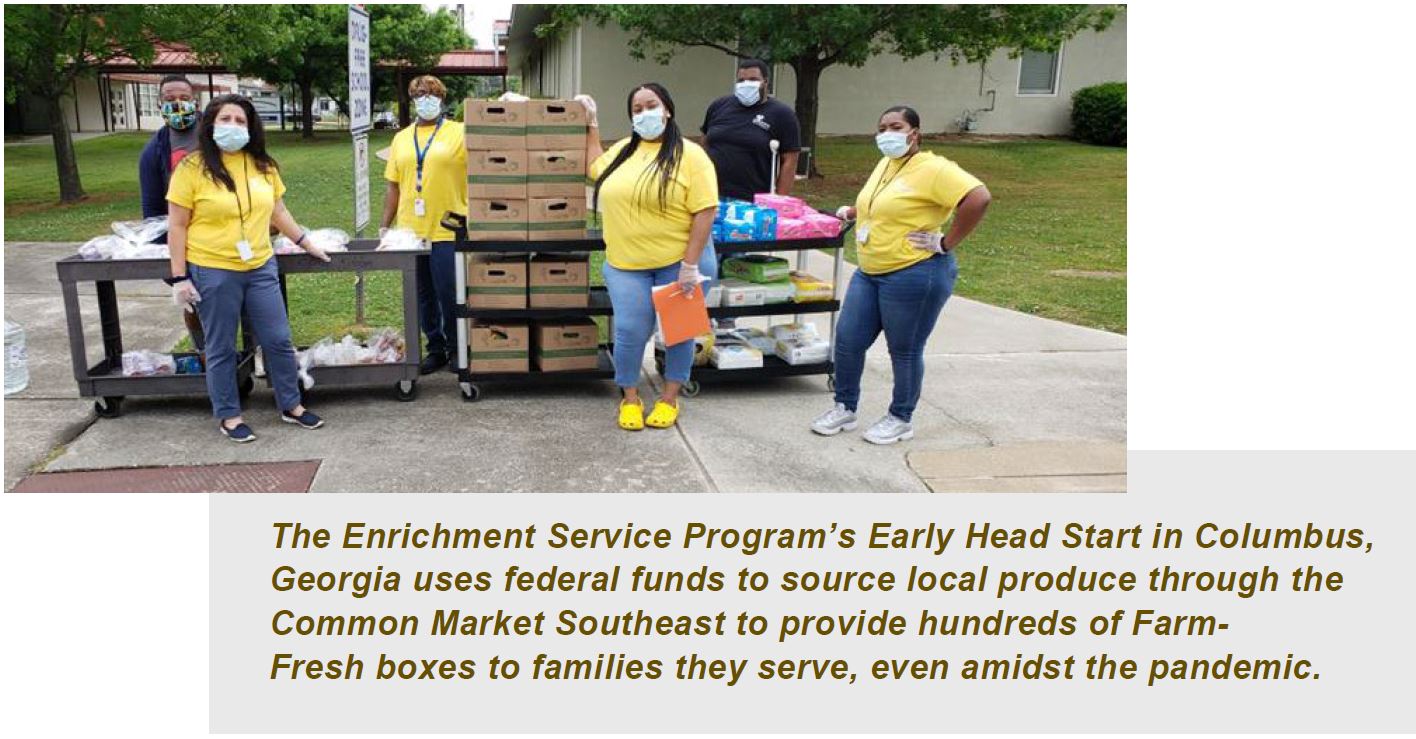
Despite closures, ECE centers have been able to continuously provide food to families. By accessing federal funds, ECE centers reduce hunger and malnutrition and put money into the local economy.
Resources that Promote Wellness
As a key betoken of contact to families with children aged birth to five, ECE centers are a health and well-existence resources hub, providing direct services or referrals such as wellness care navigation, developmental screening and infant and early babyhood mental health.
- In 2019, Head Start and Early on Head Starting time programs increased the number of all children who were up-to-date on a schedule of age-appropriate preventive and primary health care from 46 percent at enrollment to 84.vi pct by the finish of the year. Many Head Kickoff and Early Head Start programs take a Mental Wellness Specialist or Licensed Counselor to promote social and emotional competence in children and support families with issues such as substance abuse, domestic violence or stress.
- Babies Can't Wait (BCW) provides early on developmental screenings to young children and assists in coordinating any early intervention. This program is integrated into many ECE programs; the early detection and treatment of developmental and intellectual disabilities can help better outcomes for children and their families. Since early on educators usually refer families to BCW, the number of children beingness screened has decreased during the pandemic.
- ECE centers piece of work with community partners to provide home visiting services or in-house parent education aimed at teaching parenting skills that build their children's social-emotional competence, physical wellness and early brain evolution. These evidence-based programs are highly constructive, merely at that place is limited availability. Home visiting programs are only in 20 counties across Georgia.
Although the ability and requirements of ECE centers to serve every bit health and wellness advocates varies by funding source, all programs and parents take admission to Kid Care Resource and Referral agencies (CCR&Rs). CCR&Rs help parents and professionals navigate additional sources of public assistance. The majority of CCR&Rs are equipped to connect individuals with resources such as housing assistance, wellness insurance programs and child care tax credit information.
Access to Kid Intendance and Early on Pedagogy
The boilerplate yearly toll of ECE in Georgia is over $xv,000 for 2 children, which amounts to half the total annual income of a family unit living in poverty.[eight] While assistance is available in all 159 counties, it is not plenty to serve all of the estimated 364,000 eligible children in low-income working families who need information technology.[9]
| What ECE Programs are Bachelor to Support Georgia's Working Families? | ||||
| Programme | Age Served | Toll | Annual Capacity | Access/Eligibility |
| Early Head Start | 0 to 2 years-quondam | None | ~v,000 children | 100% of federal poverty level (FPL) ($26,200 annually for a family of iv); there is a waitlist and very few programs in area |
| Head Start | 3 to 5 years-old | None | ~19,500 children | 100% FPL; there is a waitlist and are few programs in area |
| Immigrant & Seasonal Caput Start | 0 to 5 years-old | None | ~360 children | 100% FPL; merely 4 locations in the state |
| Program | Age Served | Cost | Annual Capacity | Admission/Eligibility |
| GA Land-Funded Pre-K | 4 to 5 years-old | None | ~80,000 children | Whatsoever four-year-former who is a resident in the state; however, there are over iv,000 children on the waitlist due to capacity |
| Licensed Child Care Programs | iii months and up | ~$8,000/ year per child | Market-Driven | Subsidies (CAPS) are provided to 75,000 children annually; withal, well-nigh 48,000 children were declined in 2019 due to limited capacity and/or ineligibility |
Note: Citizenship is non required for whatever plan eligibility
Sources: Georgia'due south Cross Agency Child Information System (2019); Georgia Department of Early on Intendance and Learning, Bright from the Start 2019 Annual Report; GBPI 2021 Georgia Budget Primer, p. 37.
Georgia Pre-Thou
One of the most widely recognized and utilized programs is Georgia Pre-K, which is funded through the country's lottery revenues. Although touted as a universal program, serving over 80,000 of Georgia'southward 4-year-olds at no cost annually, information technology is not able to provide space for every eligible applicant. There are currently about four,000 children on the waiting list.
Enrollment of children from depression-income families in Georgia state-funded pre-K programs varies greatly by county. In all, only xxx percent of eligible children from low-income families across the state are enrolled.[10] Stagnant funding keeps Georgia's pre-K program from expanding.[11] Georgia provides less per student in the programme than the state did a decade agone. In FY 2011 Georgia allocated the equivalent of $5,050 per student. When taking inflation into account, that is $352 more than in the current budget cycle.
Head Start and Early Head Start
Head Start and Early Caput Beginning (HS/EHS) exclusively serve families with low incomes and focus on child and family well-being as a core component. By engaging with parents and customs partners, HS/EHS works to connect families with chief medical homes, oral health, mental health and substance abuse treatment resource.
At that place are over 160,000 children nether age 5 living at or below poverty in Georgia; yet, the program currently only has chapters for approximately 25,000 children annually. The program prioritizes children with special needs and disabilities.[12]
Private Early Care and Education
Exterior of fully funded programs, child care is provided in a diversity of settings: licensed child care learning centers, exempt providers (such as school-based or faith-based child care programs), licensed family unit child care learning homes and informal kid intendance providers.
The Child Intendance and Parents Services (CAPS) program supports early educational activity by providing child care subsidies to low-income families while they work, get to school or trainings or participate in other work-related activities. In FY 19, the CAPS program provided over 75,000 children subsidies to attend kid care. For that year they renewed 27,000 scholarships and reviewed over 82,000 new CAPS applications. This means about 48,000 children whose parents were seeking kid care support were not accepted into the CAPS plan due to limited chapters or ineligibility.[13]
These federal funds are also intended to enhance the quality and availability of child care across Georgia. Providers accepting CAPS are reimbursed more per child if they are Quality Rated, a credentialing plan where providers work to deliver college levels of care, education and well-being services to children and families. DECAL is currently working to assistance child care centers who take CAPs to as well participate in the Quality Rated program; however, non all centers will qualify for assistance.[14]
The Lasting Touch on of Early Education on Health and Return on Investment
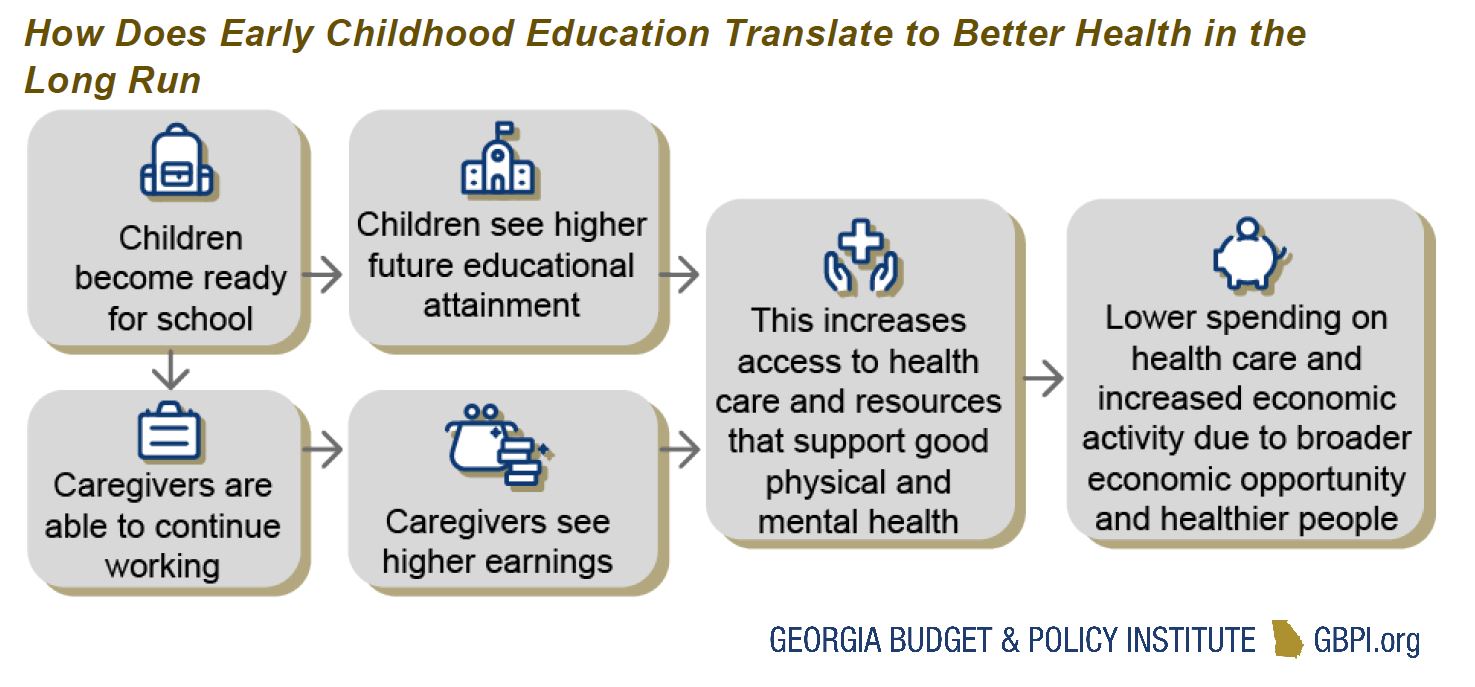
Early childhood didactics not only helps children and families with the resource to support their health and well-existence today, but it tin can also help Georgia take a healthier population in the futurity and reduce long-term health intendance costs. The long-term benefits can be seen in the outcomes for children enrolled in the programs and their parents or caregivers, as well as in the price-benefit of early babyhood education.
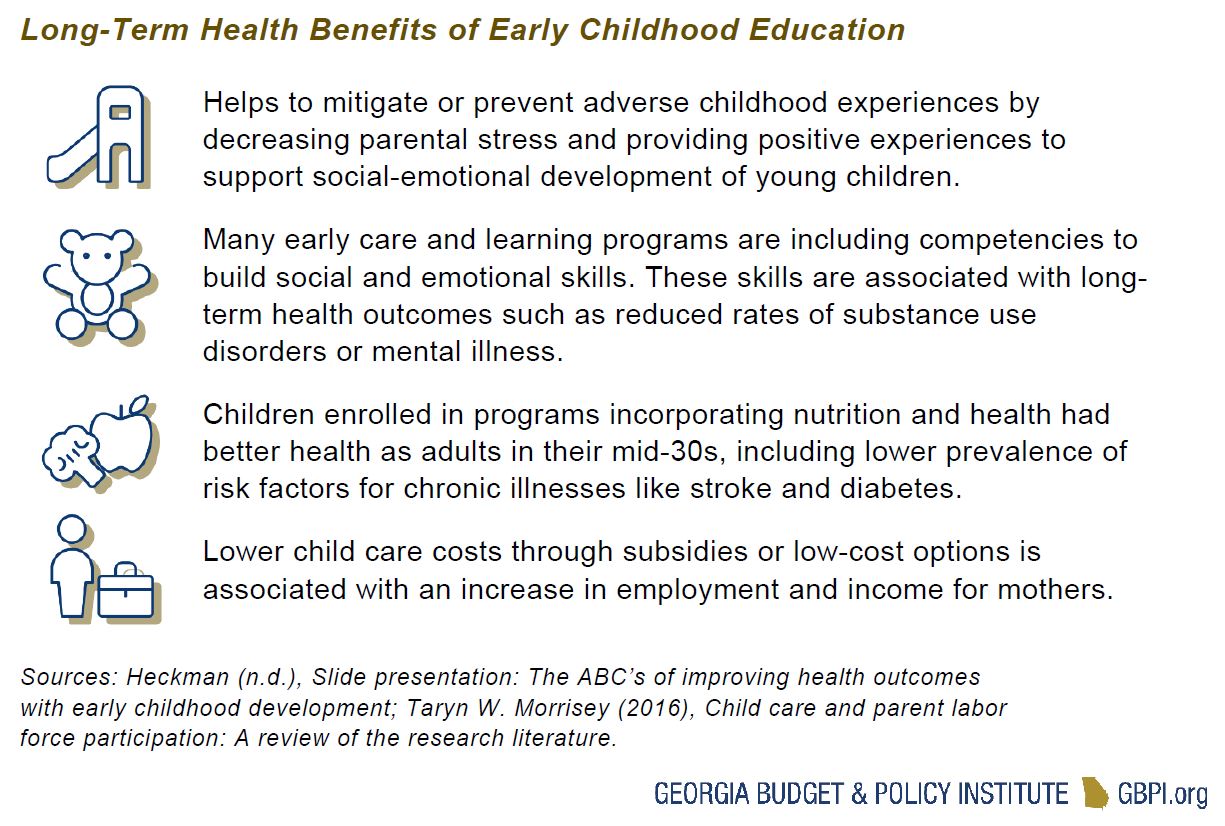
Investing in early on didactics programs and supporting these programs to include health components (due east.thousand., screenings and diet) can help the country improve the health of children and their families and increment their earnings while producing a return on investment through savings in remedial education and health care costs. An analysis of over one hundred public help programs plant that investing direct in health and education for children in households with low incomes has the all-time cost-benefit ratios.[15] 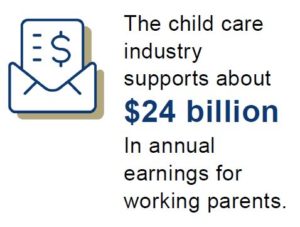
In add-on to the return on investment, adequate early care and education can help avoid costs associated with failing to brand these programs more than attainable. Challenges with securing child care pb to about a $i.75 billion loss in annual economic activity due to employee absences and turnover and another $105 million in lost state tax revenue each year as parent income declines.[16]
Lastly, child care providers undergird the economy every bit a critical industry and support for working people. A 2016 economic written report revealed Georgia's early care and educational activity industry generates $4.7 billion in economic activity each year and employs nearly 85,000 Georgians. Additionally, the level of parents' annual earnings supported by the availability of child care in the land is $24 billion.[17]
Early Childhood Education every bit a Tool for Wellness Equity
Racism and poverty can create many disadvantages during early on childhood that influence health and well-being throughout life. Structural racism, an enduring collection of discriminatory practices and racial biases across several facets of life such equally health and pedagogy, limits the ability for parents to earn higher wages and build wealth, denies equitable access to healthy living conditions to families of color and leads to bias against children and parents of color—which results in chronic stress for Black and Brown parents at all income levels and higher rates of expulsion from preschool for Black children.[eighteen]
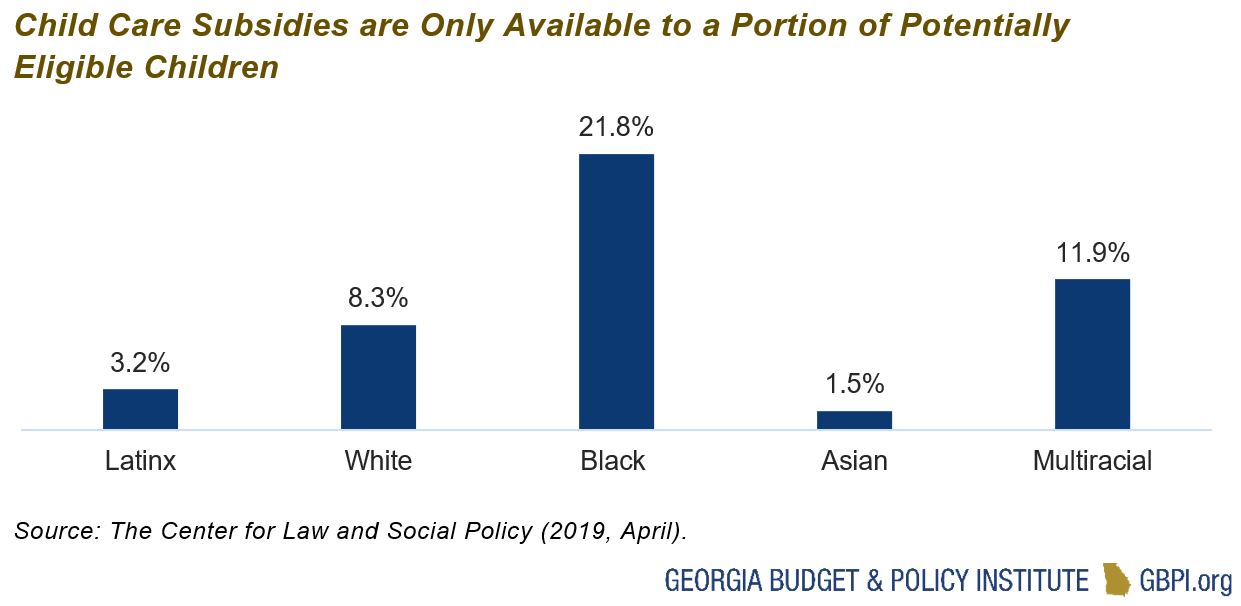
Blackness students in Georgia are 3.6 times more probable to be suspended than white students. Georgia passed legislation in 2018 that limits expulsions and suspensions of v days or more for public preschool to tertiary grade past requiring the student to receive a multi-tiered system of supports outset. Only boosted steps like using supports to forestall the need for suspension or expulsion and working to overcome racial bias during staff professional development can improve health equity past ensuring Black children receive the benefits of early instruction without disruptions.[19] Furthermore, increasing the equitable access to child care subsidies plays an important role in realizing the health benefits of early on childhood educational activity. While merely xv percent of Georgia children who could be eligible for child care subsidies, a far lower share of potentially eligible Latinx and Asian children receive kid care subsidies.[20] Making early babyhood education programs more accessible and affordable and removing barriers children of color face in early on education settings tin assist reverse the furnishings of structural racism on the healthy development of children.
Maximizing the office of early on education in promoting health disinterestedness also includes policy solutions to support the wellness of the early childhood education workforce. Child care workers in Georgia earn an annual average bacon of $20,330, and 53 percent nationally are enrolled in public assistance programs, compared to 21 per centum of the overall workforce. [21], [22] Over half of the lead teachers for infants/toddlers and 3-yr-olds in child care learning centers are Black.[23] Many child intendance workers may not be able to afford health coverage and experience high levels of stress and depression, partly due to the low pay. In add-on to working on increasing wages for these workers, the state can consider options similar enacting a refundable earned income tax credit for low wage earners to continue more of their wages and expanding Medicaid, which could embrace over 7,000 child care workers who are currently without health insurance coverage.[24]
Policy Solutions to Improve Health in Georgia through Early Childhood Education
Admission to affordable, quality early childhood educational activity was a challenge before the COVID-nineteen pandemic, and the ongoing work to increase access to these programs will permit more children and families to realize the health benefits that come with participation in early childhood didactics programs. At present information technology is critical to back up early didactics programs similar child care centers to sustain them across the pandemic and to build on the state's efforts to coordinate cantankerous-sector collaboration between early childhood education and health through programs like Babies Can't Wait. Some key recommendations at the intersection of early childhood teaching and health include:
Building on the recent boost in kid care funding by expanding access to the CAPS plan.
In 2018, DECAL received a historic funding boost of $93 one thousand thousand, which allowed the bureau to brand improvements like increasing reimbursement rates for infants and toddlers, hiring more back up staff for children'southward social and emotional health needs and supporting early learning workforce evolution.[25] State lawmakers tin continue this progress by increasing the amount of child care subsidies available to low-income families through CAPS. The programme is fix to support about 50,000 children a twelvemonth, but there are a full of 364,000 children who potentially need affordable kid care due to lower family unit incomes.
Increasing coordination between land health agencies and DECAL and continuing investments in cross-sector initiatives.
Through programs like Babies Tin can't Await and domicile visiting, the Section of Public Health is able to coordinate services with early on education programs to deliver testify-based targeted early interventions. Georgia can build on this with other health agencies and health providers. The Section of Behavioral Health and Developmental Disabilities does not currently include children younger than four in its System of Care State Plan. The agency is reviewing the plan and can consider extending the plan to include children nether 4.[26] The Department of Customs Health, which runs the Medicaid program, can update their reimbursement policy to allow payment for services similar social-emotional screenings for infants and toddlers and dyadic handling—where a therapist treats the child and caregiver together.[27]
Federal lawmakers should include funding for child care programs every bit part of the COVID-xix relief efforts.
Child care programs crave boosted funding to remain in business organisation after losing money due to closures and reduced enrollment and to provide care to essential workers. An allocation of $50 billion in federal funding for child intendance would help cover over v months of emergency care and relief. Using the aforementioned formula that determined funding distribution in the CARES Act, this would bring $2.i billion to back up Georgia's kid care programs.[28]
Give thanks you lot to Allison Setterlind, State Head Kickoff Collaboration Director at the Georgia Section of Early Care and Learning, Wande Okuronen-Meadows at Petty Ones Learning Heart and Callan Wells, Hanah Goldberg and Jessica Woltjen at Georgia Early Education Alliance for Prepare Students (GEEARS) for your insights and resources that helped inform this study.
Endnotes
[1] Georgia Budget and Policy Found (2020, August). 2021 Georgia Budget Primer. https://gbpi.org/georgiabudgetprimer/
[2] The Annie E. Casey Foundation. (2020, August).Child population by historic period group in Georgia. KIDS COUNT Data Center. https://datacenter.kidscount.org/data#GA/2
[three] Quality Rated. (2020). https://families.decal.ga.gov/
[four] Georgia Early on Education Alliance for Ready Students. (2020, August).Simply non sustainable: Georgia parents' experiences during the COVID-xix crunch. https://geears.org/wp-content/uploads/COVID19-Family-Feel-Survey.pdf
[5] Gould, Due east. & Shierholz, H. (2020). Not everybody tin can work from home: Black and Hispanic workers are much less probable to be able to telework. Economic Policy Found. https://www.epi.org/weblog/black-and-hispanic-workers-are-much-less-likely-to-be-able-to-work-from-home/
[6] National Clan for the Education of Young Children. (2020, March 27).A state-past-state look at child intendance in crisis: Understanding early effects of the coronavirus pandemic. https://www.naeyc.org/sites/default/files/globally-shared/downloads/PDFs/our-work/public-policy-advancement/state_by_state_child_care_crisis_coronavirus_surveydata.pdf
[vii] Georgia Early Education Alliance for Ready Students. (2020, March 30). GEEARS Statement: Social Distancing Guidance Should Extend to Kid Care Sector. https://geears.org/news/social-distancing-child-intendance-sector/
[eight] Childcare Aware. (2019).Cost of child care in Georgia. https://info.childcareaware.org/hubfs/2019%20Price%20of%20Care%20State%20Sheets/Georgia.pdf?utm_campaign=2019%20Cost%20of%20Care&utm_source=2019%20COC%20-%20GA
[9] Georgia Department of Early Care and Learning. (2019).CAPS Policy – Priority Groups.
[10] The Annie Eastward. Casey Foundation. (2017). New written report shows racial barriers prevent children of color and immigrant children from reaching potential, post recession. https://www.aecf.org/web log/new-report-shows-racial-barriers-prevent-children-of-color-and-immigrant-ch/
[xi] Lee, J. (2020, June 17). Keeping pre-Yard stable helps Georgia children and parents. Georgia Budget and Policy Institute. https://gbpi.org/keeping-pre-k-stable-helps-georgia-children-and-parents/
[12] Georgia's Cross Agency Kid Information System. (2019). world wide web.gacacds.com
[13] Georgia Department of Early Care and Learning, Bright from the Start. (2020). 2019 annual report. https://world wide web.decal.ga.gov/documents/attachments/BFTSAnnualReport2019.pdf
[14] Camardelle, A. (2019, June 27). Georgia's boost in child care funding. Georgia Budget and Policy Institute. https://gbpi.org/georgias-heave-in-child-care-funding/
[xv] Hendren, North., & Sprung-Keyser, B. (2020). A unified welfare analysis of regime policies. The Quarterly Journal of Economics, 135(three), 1209–1318. https://doi.org/ten.1093/qje/qjaa006
[sixteen] Goldberg, H., Cairl, T., & Cunningham, T. J. (2018). Opportunities Lost: How Child Intendance Challenges Affect Georgia'southward Workforce and Economy. Georgia Early Education Alliance for Ready Students. http://geears.org/wp-content/uploads/Opportunities-Lost-Report-FINAL.pdf
[17] Brilliant from the Start: Georgia Department of Early Care and Learning. (2016, June). Economic Impact of the Early Care and Instruction Industry in Georgia. http://www.decal.ga.gov/documents/attachments/EconImpactReport.pdf
[eighteen] Braveman, P., Acker, J., Arkin, East., Bussel, J., Wehr, M., & Proctor, D. (2018, May). Early Childhood Is Critical to Health Disinterestedness. Robert Wood Johnson Foundation. https://www.rwjf.org/en/library/research/2018/05/early on-childhood-is-disquisitional-to-health-equity.html
[19] National Black Kid Development Plant. (2019). State of the Black child report card: Georgia. https://www.nbcdi.org/sites/default/files/resource-files/NBCDI%20SOBC%20Report%20Card%20Georgia.pdf
[20] Ullrich, R., Schmit, S., & Cosse, R. (2019, April). Inequitable access to child care subsidies. The Eye for Police and Public Policy. https://www.clasp.org/sites/default/files/publications/2019/04/2019_inequitableaccess.pdf
[21] Brilliant from the Start: Georgia Department of Early Care and Learning. (2016, June). Economic impact of the early on care and education manufacture in Georgia. http://www.decal.ga.gov/documents/attachments/EconImpactReport.pdf
[22] National Academies of Sciences, Technology, and Medicine, Health and Medicine Sectionalization, Lath on Population Health and Public Health Practise, Commission on Applying Neurobiological and Socio-Behavioral Sciences from Prenatal Through Early Babyhood Development: A Health Equity Approach. (2019). Vibrant and salubrious kids: Adjustment science, practise, and policy to advance health equity. Negussie, Y., Geller, A., & DeVoe, J. E. (Eds.). National Academies Printing. https://www.ncbi.nlm.nih.gov/books/NBK551492/
[23] Bright from the First: Georgia Department of Early Care and Learning. (2016, June). Economic impact of the early on care and teaching industry in Georgia. http://world wide web.decal.ga.gov/documents/attachments/EconImpactReport.pdf
[24] Sweeney, T. Georgia Upkeep and Policy Institute & Georgians for a Healthy Future. (2015, September 23). Understanding Medicaid in Georgia and the opportunity to amend it. Georgia Budget and Policy Institute & Georgians for a Healthy Future. https://gbpi.org/understanding-medicaid-in-georgia-and-the-opportunity-to-improve-it/
[25] Camardelle, A. (2019, June 27). Georgia's heave in child intendance funding. Georgia Budget and Policy Found. https://gbpi.org/georgias-boost-in-child-care-funding/
[26] Georgia Early on Education Alliance for Prepare Students & National Center for Children in Poverty. (2019, September). What Policymakers in Georgia need to know about infant-toddler social-emotional wellness. http://geears.org/wp-content/uploads/IECMH-Brief-for-Policymakers-FINAL.pdf
[27] Georgia Early Educational activity Alliance for Ready Students & National Center for Children in Poverty. (2019, September). What Policymakers in Georgia need to know about infant-toddler social-emotional wellness. http://geears.org/wp-content/uploads/IECMH-Brief-for-Policymakers-FINAL.pdf
[28] Schmit, S. (2020, May). Why nosotros need $50 billion in pandemic child care relief: A country-by-country estimate. The Eye for Law and Social Policy. https://www.clasp.org/sites/default/files/publications/2020/05/2020_50billionpandemicchildcare_0.pdf
faulknerpooft1936.blogspot.com
Source: https://gbpi.org/support-early-childhood-education-programs-for-health-and-well-being-of-georgia-families/
0 Response to "Georgia Families Is a Program That Is Associated With What Area of Funding?"
Publicar un comentario